

Tolkien & Trees, pt. 4: The Ents!
Tree-defenders vs. Tree-killers

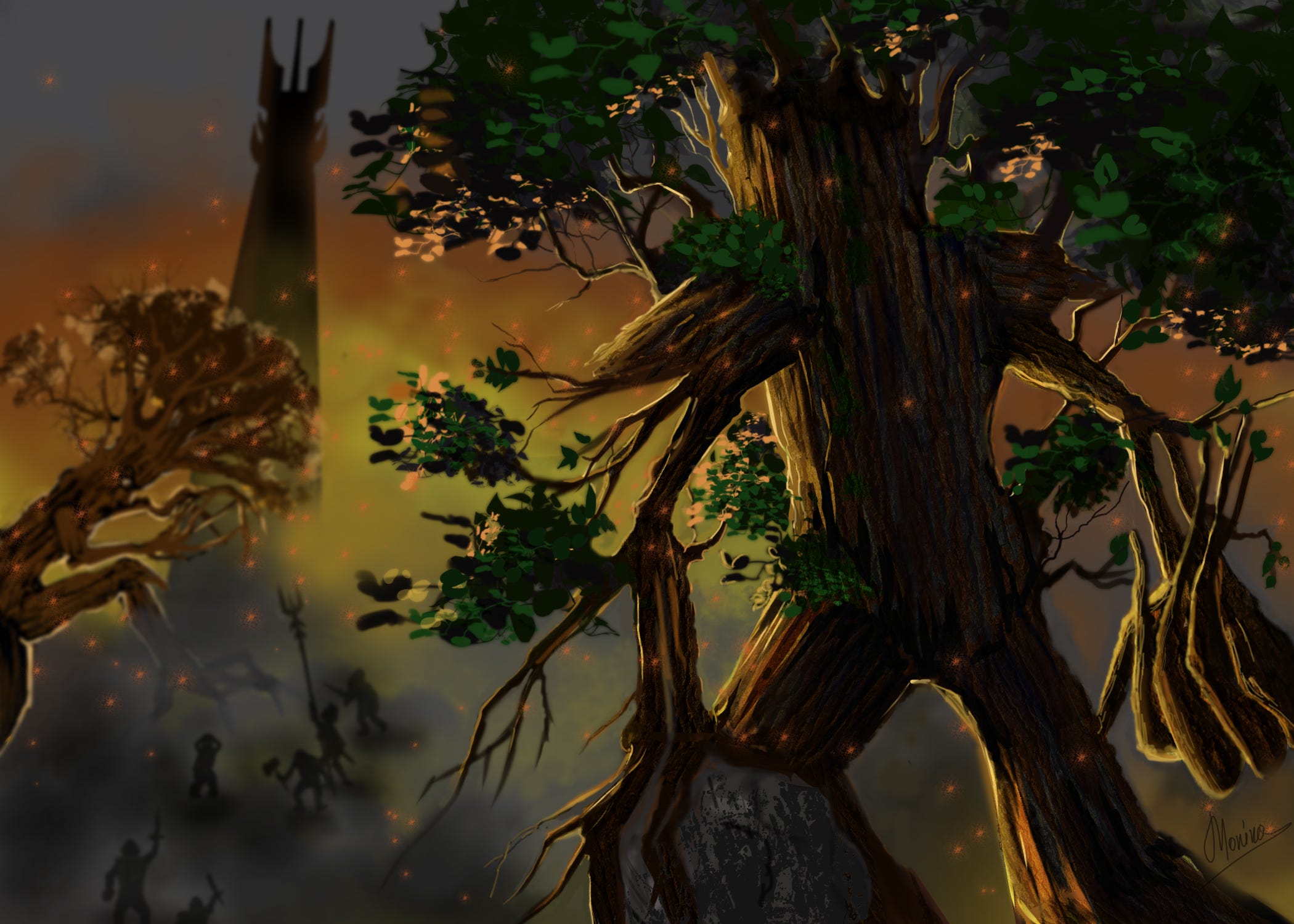
The Ents are a fan favorite in J.R.R. Tolkien’s Lord of the Rings (LotR), and no wonder: Narratively, they’re the tree defenders vs. the tree killers, and they win. Metaphorically, they are Nature fighting Industry, the wild resisting exploitation, freedom asserting itself against oppression. What’s not to love?
All this reflects Tolkien’s own heart, as we see in his letters:
I am (obviously) much in love with plants and above all trees, and always have been; and I find human maltreatment of them as hard to bear as some find ill-treatment of animals. (1955, to his publisher)
It is not the not-man (e.g. weather) nor man (even at a bad level), but the man-made that is ultimately daunting and insupportable. If a ragnarök would burn all the slums and gas-works, and shabby garages, and long arc-lit suburbs, it [could] for me burn all the works of art – and I’d go back to trees. (1944, to his son, Christopher)
In all my works I take the part of trees as against all their enemies. (1972, to the Daily Telegraph)
It would be unfair to compare the Forestry Commission with Sauron because as you observe it is capable of repentance; but nothing it has done that is stupid compares with the destruction, torture and murder of trees perpetrated by private individuals and minor official bodies. The savage sound of the electric saw is never silent wherever trees are still found growing. (Ibid)
Every tree has its enemy, few have an advocate. (Too often the hate is irrational, a fear of anything large and alive, and not easily tamed or destroyed, though it may clothe itself in pseudo-rational terms.) (1962, to Jane Neave, his aunt)
In Tree and Leaf, speaking of a poplar he could see from his window:
It was suddenly lopped and mutilated by its owner, I do not know why. It is cut down now, a less barbarous punishment for any crimes it might have been accused of, such as being large and alive. I do not think it had any friends, or any mourners, except myself and a pair of owls.
All parts in this series can be found here
Given Tolkien’s lifelong passion for trees and his antipathy towards those who abuse them, one might assume that the Ents had a place in his legendarium from the earliest days of its imagining. But that’s not how it happened, which points to how commonly people misunderstood Tolkien’s “world building.” It wasn’t that he first pictured everything about Middle-earth, set it into stone, and then laid meticulously planned-out plot lines on top of it. Rather, as he says right off the bat in the Foreword to LotR, “This tale grew in the telling.” It’s true that the linguistic underpinnings of the legendarium were quite sophisticated, and probably unparalleled in fantasy literature to this day, but in terms of characters, races of beings and events, it was often a process of discovery for Tolkien, definitely in the case of the Ents. In a 1955 letter to W. H. Auden, he writes:
Take the Ents, for instance. I did not consciously invent them at all. The chapter called ‘Treebeard’, from Treebeard’s first remark on p. 66, was written off more or less as it stands, with an effect on my self (except for labour pains) almost like reading some one else’s work. And I like Ents now because they do not seem to have anything to do with me. I daresay something had been going on in the ‘unconscious’ for some time, and that accounts for my feeling throughout, especially when stuck, that I was not inventing but reporting (imperfectly) and had at times to wait till ‘what really happened’ came through. But looking back analytically I should say that Ents are composed of philology [linguistics], literature, and life. [my emphasis]
Tolkien is not the only writer or artist to report an incident like this, as if “channeling.” I myself have had similar experiences, though certainly never with a result as profound as Ents. In its most rarefied form, human creativity is an encounter with the ineffable. (Which is why what’s regurgitated by large language models—colloquially known as “AI”—is no replacement; the artificial generation of text, sound or visuals will never be writing, music or art. But I digress.)
Turning to Treebeard’s “first remark,” we hear a being unlike any other in the LotR up to this point. Merry and Pippin have just escaped the orcs who kidnapped them and have run into Fangorn Forest. Fearing recapture, they don’t stop until they are some ways in, where “a queer stifling feeling came over them, as if the air were too thin or too scanty for breathing.” The atmosphere is “all very dim, and stuffy,” evocative of Mirkwood which was “still and dark and stuffy.” “Look at all those weeping, trailing, beards and whiskers of lichen!” remarks Pippin, in a hint of foreshadowing. The clouds break and they spot a sunny clearing ahead which they make for. They find at a rocky outcropping in full light, where we are given more hints.
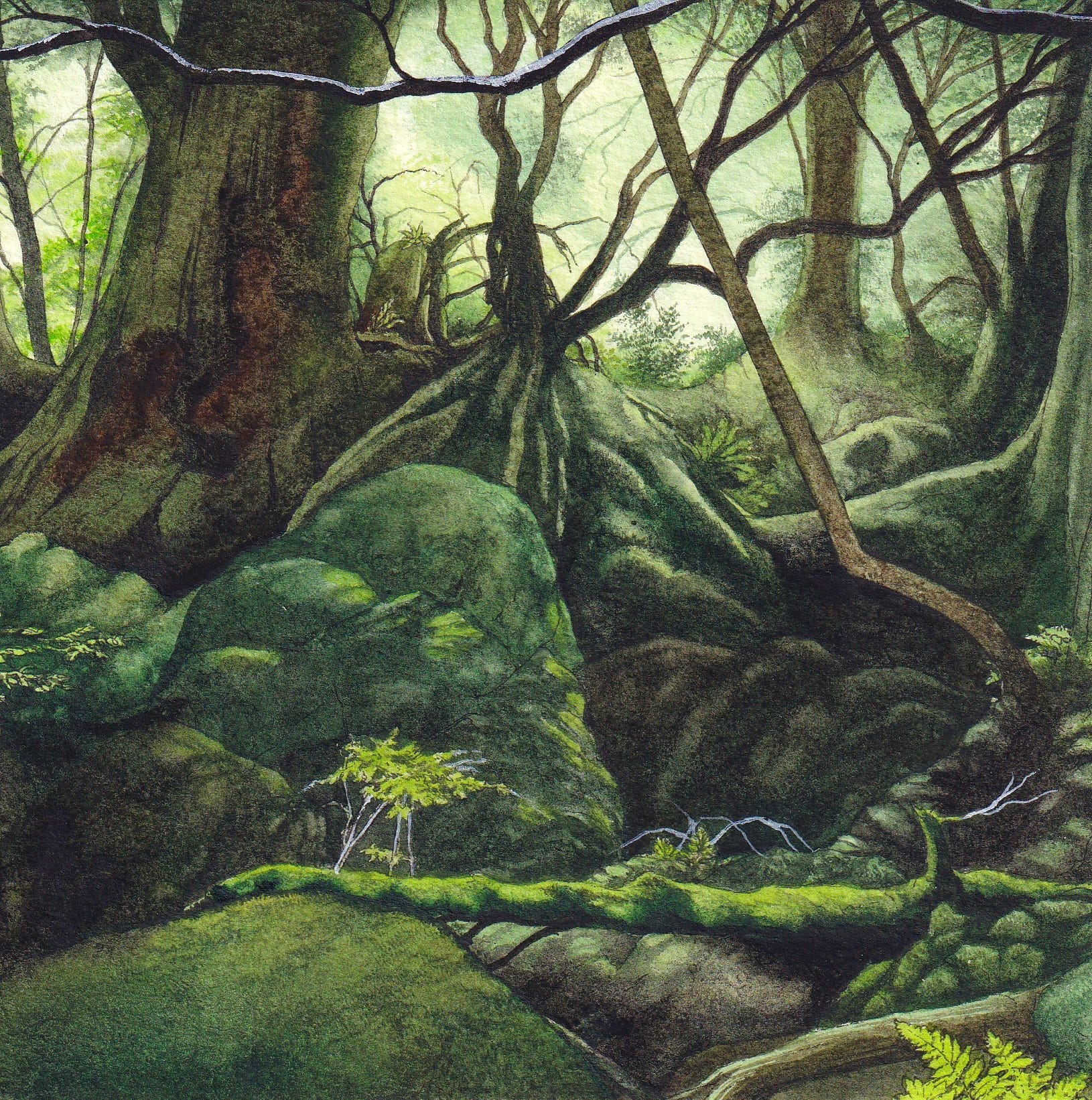
In the face of the stony wall there was something like a stair: natural perhaps, and made by the weathering and splitting of the rock, for it was rough and uneven. High up, almost level with the tops of forest-trees, there was a shelf under a cliff. Nothing grew there but a few grasses and weeds at its edge, and one old stump of a tree with only two bent branches left: it looked almost like the figure of some gnarled old man, standing there, blinking in the morning-light.
The two hobbits, feeling rejuvenated after drinking out of the Entwash, the stream that runs through the forest, climb up the stair, which seems to have been made for “bigger feet and longer legs than theirs.” They plop down at the foot of the stump and look around. They see that they have only come three or four miles into the forest and that the sun will be going behind the clouds again. Pippin says:
‘I’m afraid this is only a passing gleam, and it will all go grey again. What a pity! This shaggy old forest looked so different in the sunlight. I almost felt I liked the place.’
‘Almost felt you liked the Forest! That’s good! That’s uncommonly kind of you,’ said a strange voice. ‘Turn round and let me have a look at your faces. I almost feel that I dislike you both, but do not let us be hasty. Turn around!’ A large knob-knuckled hand was laid on each of their shoulders, and they were twisted round, gently but irresistibly; then two great arms lifted them up.
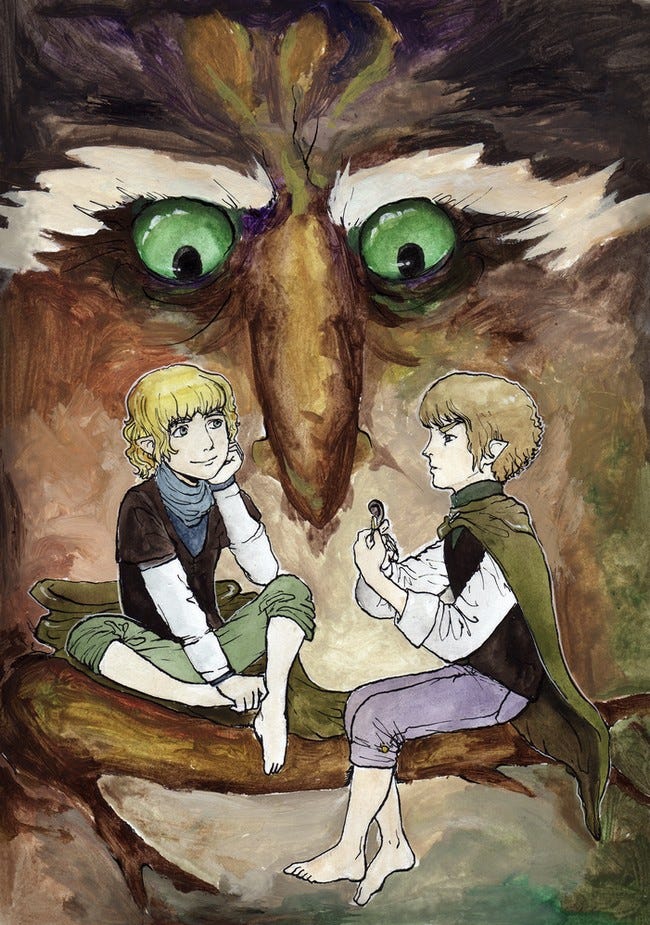
This is not the manner of speaking of any character so far. Less formal than Gandalf, Elrond, Galadriel or any of the “great” people, but not frivolous like Tom Bombadil or folksy like a hobbit. His words are neither threatening nor inviting but are definitely amusing. As is typical of Tolkien when describing one of his mythical creatures, we are not given a concise picture (and hence the wide variety of artistic interpretations):
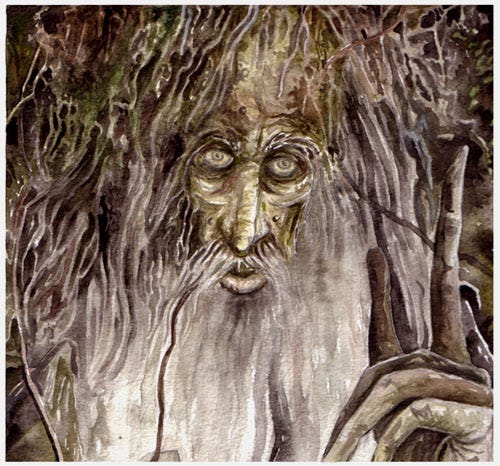
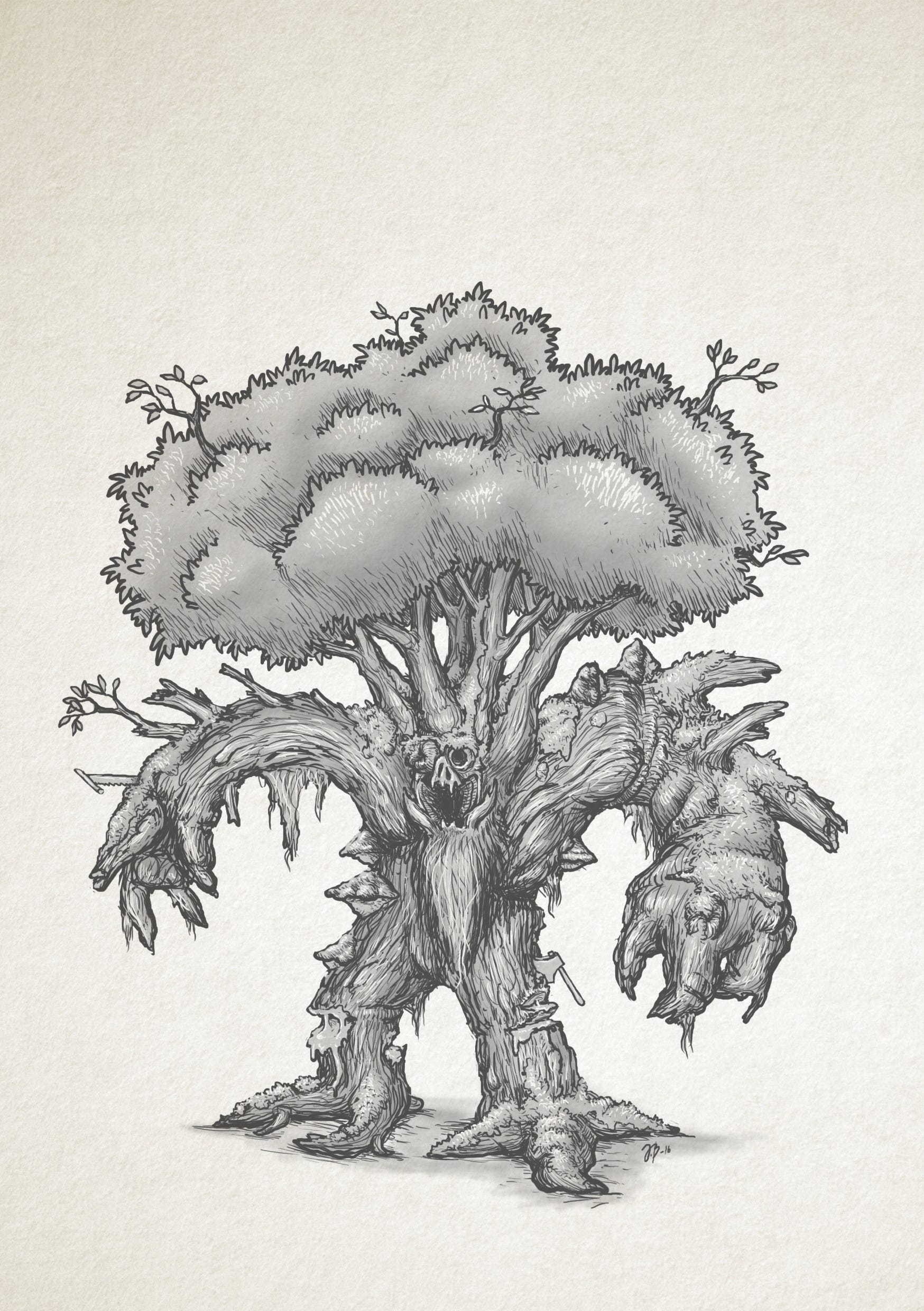
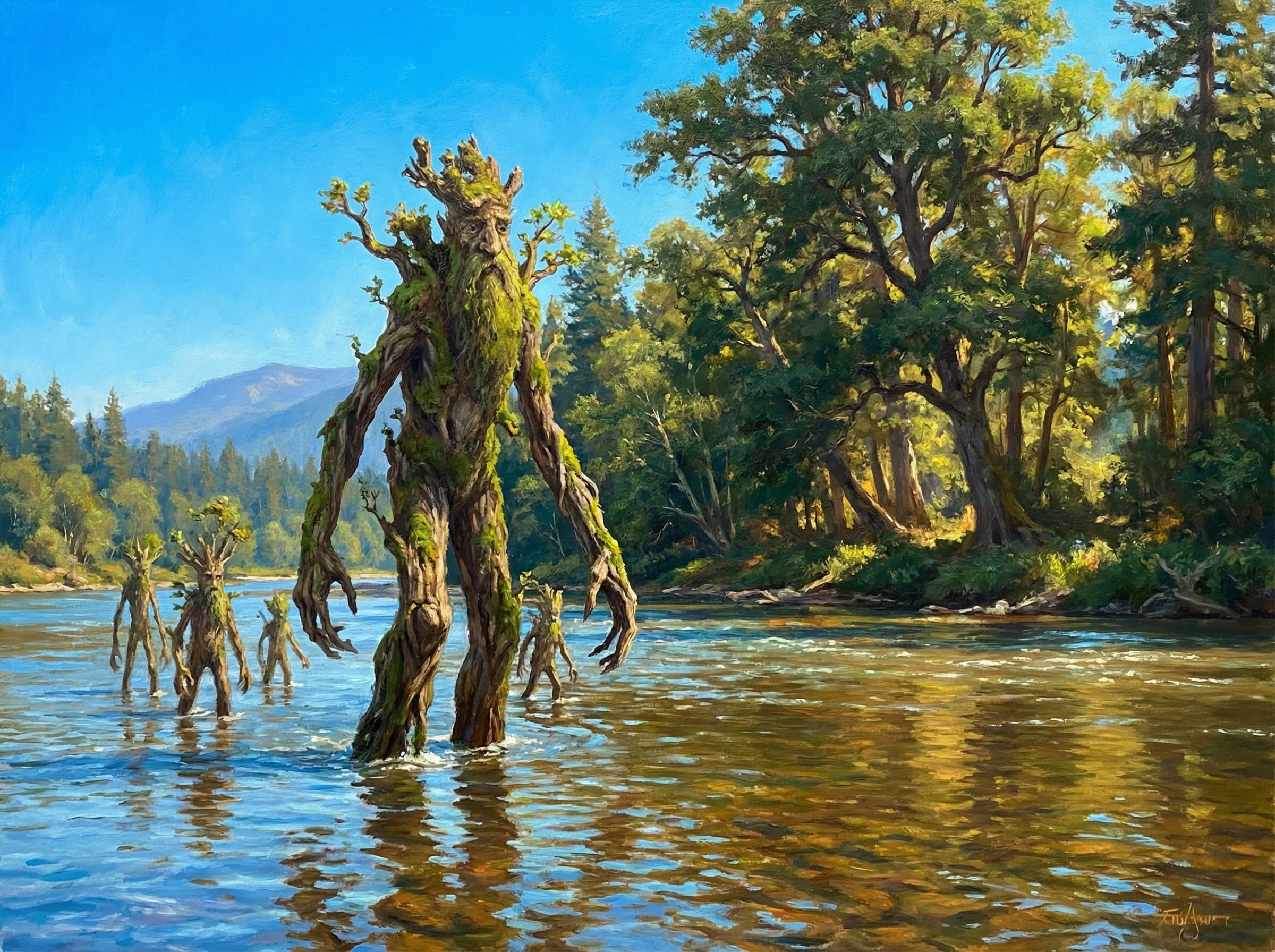
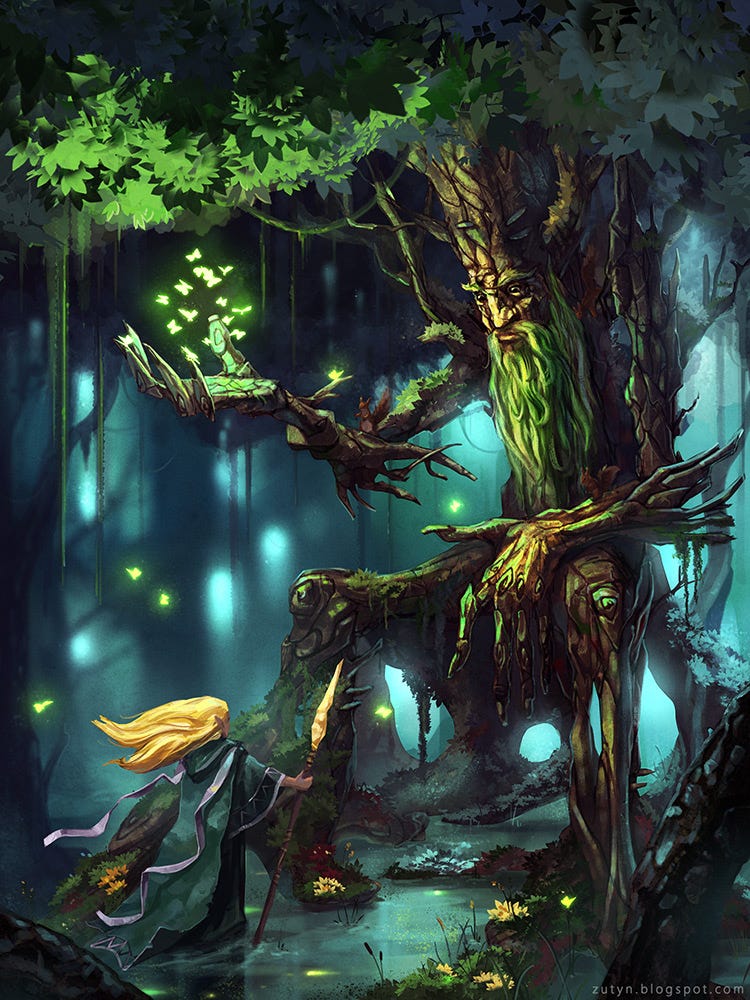
They found that they were looking at a most extraordinary face. It belonged to a large Man-like, almost Troll-like, figure, at least fourteen foot high, very sturdy, with a tall head, and hardly any neck. Whether it was clad in stuff like green and grey bark, or whether that was its hide, was difficult to say. At any rate the arms, at a short distance from the trunk, were not wrinkled, but covered with a brown smooth skin. The large feet had seven toes each. The lower part of the long face was covered with a sweeping grey beard, bushy, almost twiggy at the roots, thin and mossy at the ends. But at the moment the hobbits noted little but the eyes. These deep eyes were now surveying them, slow and solemn, but very penetrating. They were brown, shot with a green light.
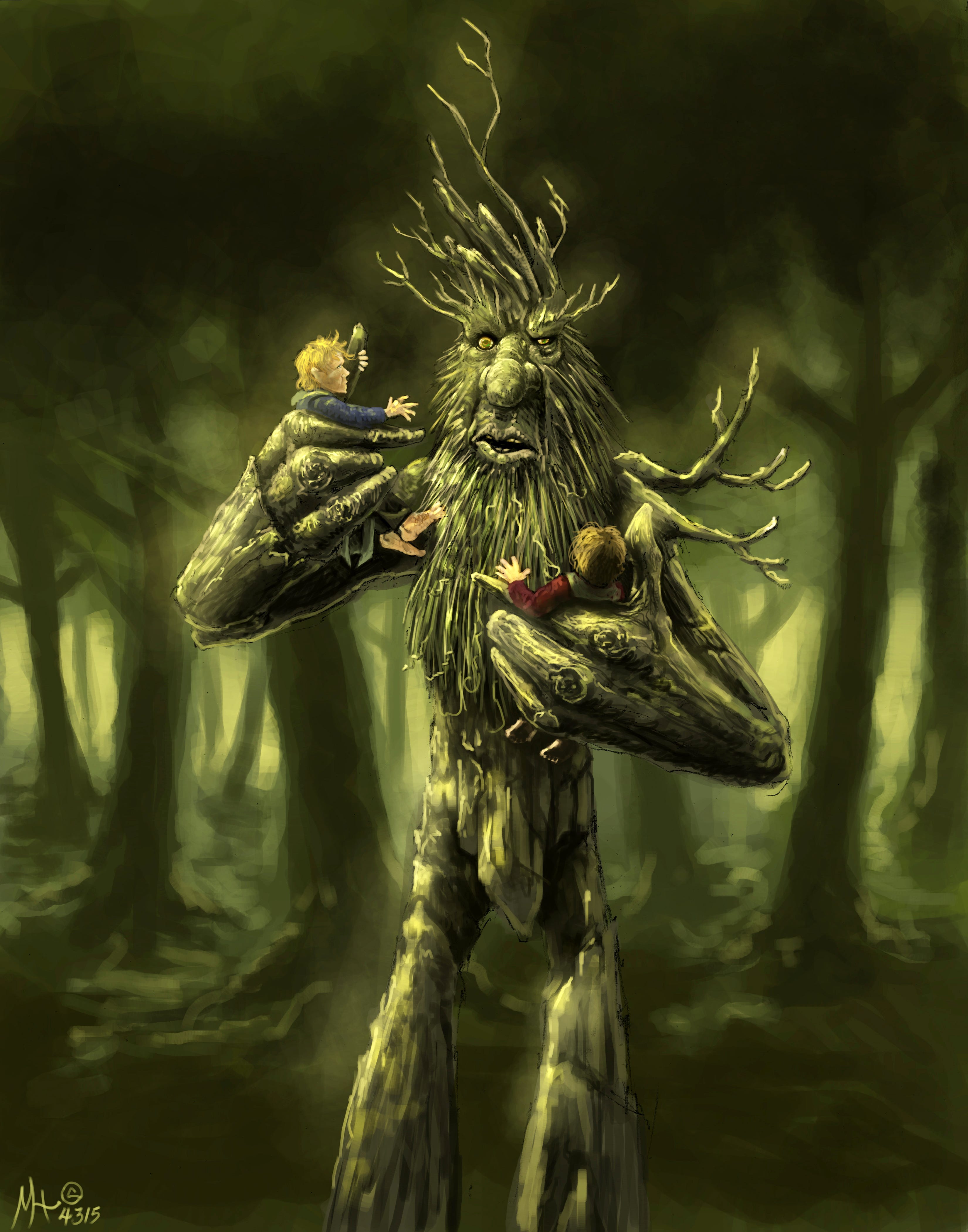
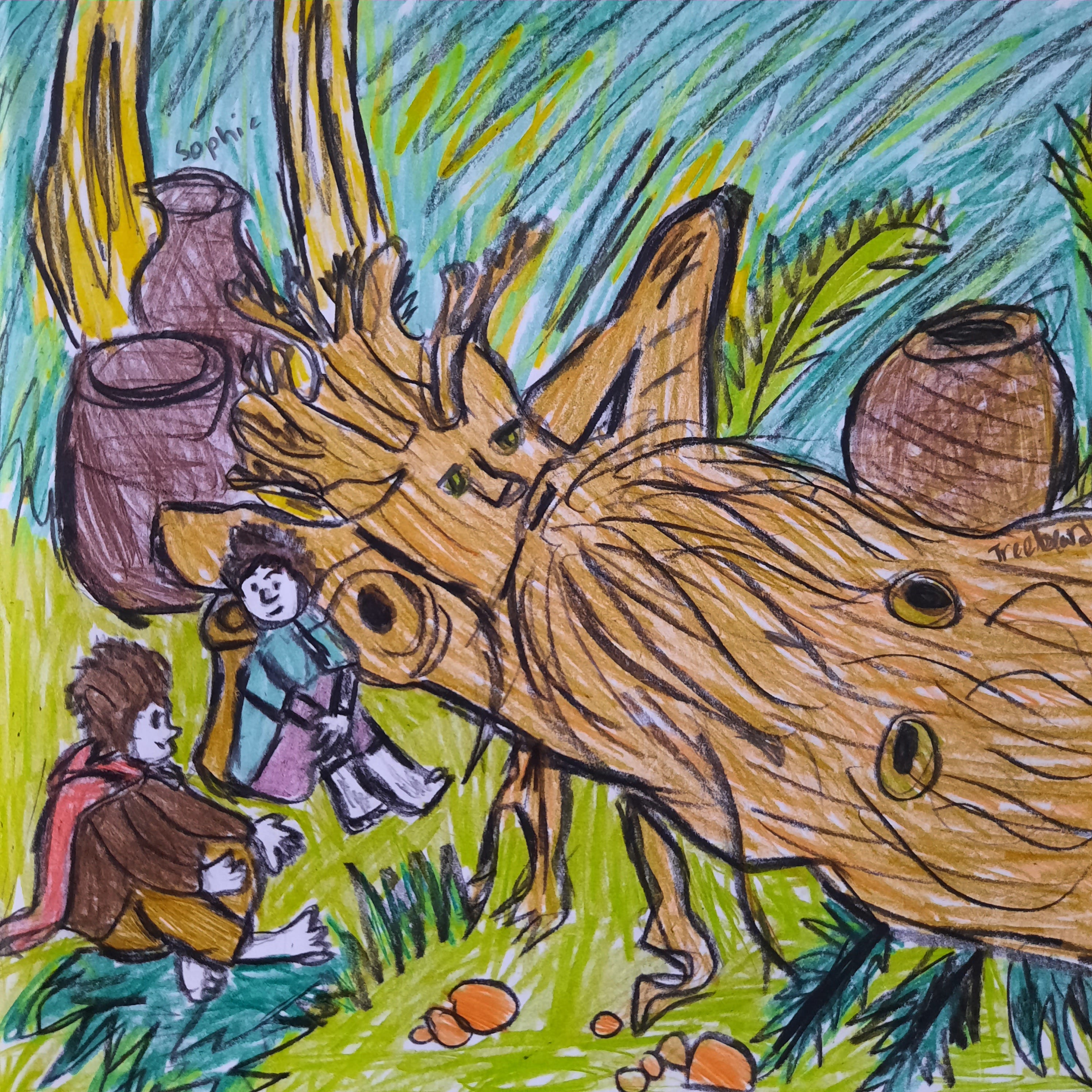
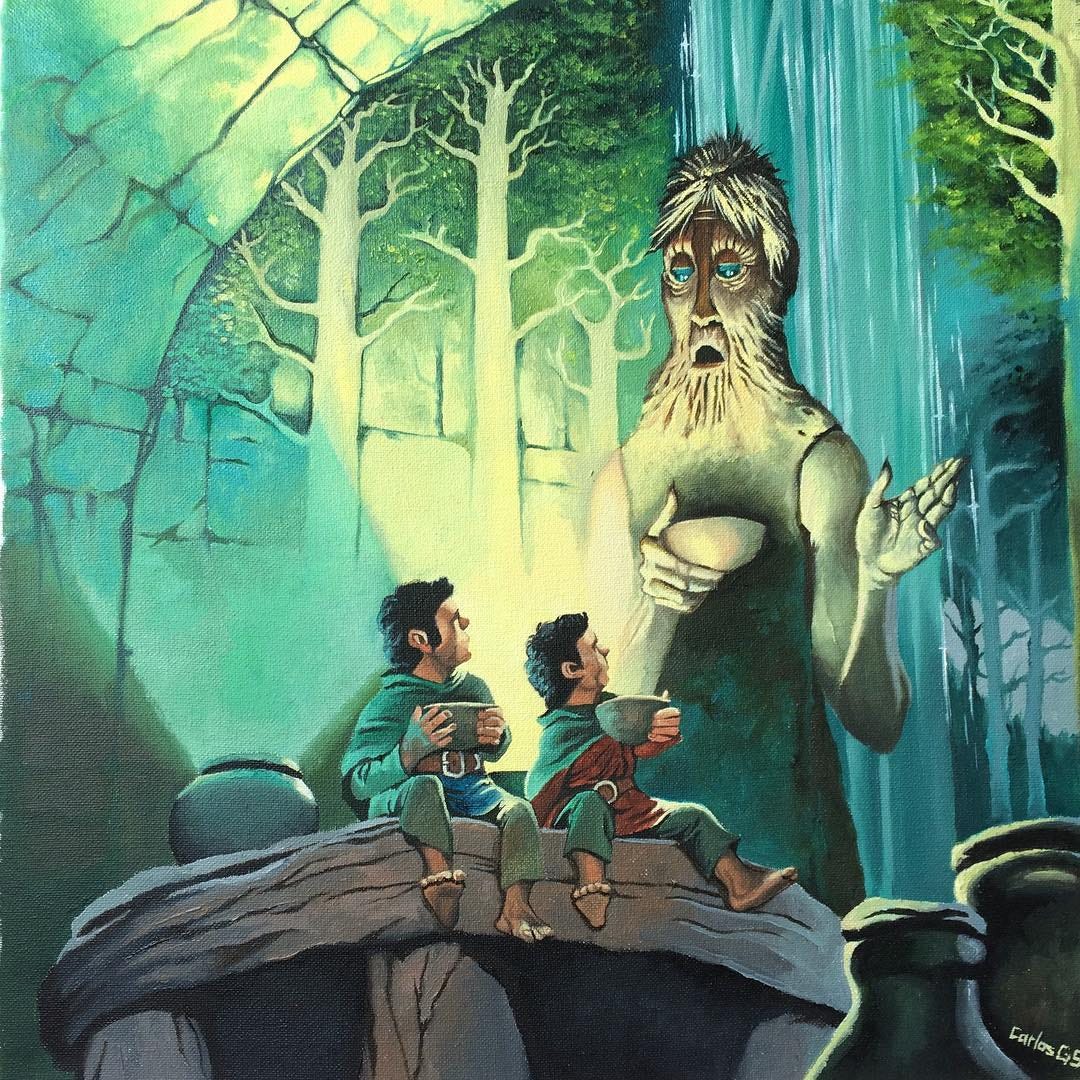
Treebeard is not at all a threat and soon the three of them are in animated conversation. Merry and Pippin have never heard of Ents, nor Treebeard of hobbits, so that’s the first order of business and we get an earful about Ents. As they talk, Treebeard carries them to one of his dwellings in the forest, out of which the Entwash flows. Here they drink some of his Ent draught, a beverage made from the stream water, which hits the hobbits like water does plants:
The effect of the draught began at the toes, and rose steadily through every limb, bringing refreshment and vigour as it coursed upwards, right to the tips of the hair. Indeed the hobbits felt that the hair on their heads was actually standing up, waving and curling and growing.
After all the weightiness of their trek since Rivendell, from the shadows of Moria to the otherworldliness of Lothlórien to the trauma of the breaking of the fellowship, this is whimsical stuff. Given Merry and Pippin’s suffering at the hands of the orcs, they certainly deserve this turn, if not to levity, at least to relief. For the reader it’s also a shift in pace and tone, which is necessary for sustaining a work of this length.
Treebeard is the first new major character to enter the LotR storyline since Galadriel, and though both are mighty figures, they are dissimilar. She is ethereal where he is earthy. She gives the hobbits haven from evil, but he—prompted by their very arrival—takes them to face it. Her power is in defending, and his in assailing. Finally, where she is categorically on the side opposed to Sauron, Treebeard is more circumspect: “I am not altogether on anybody’s side, because nobody is altogether on my side, if you understand me: nobody cares for the woods as I care for them.”
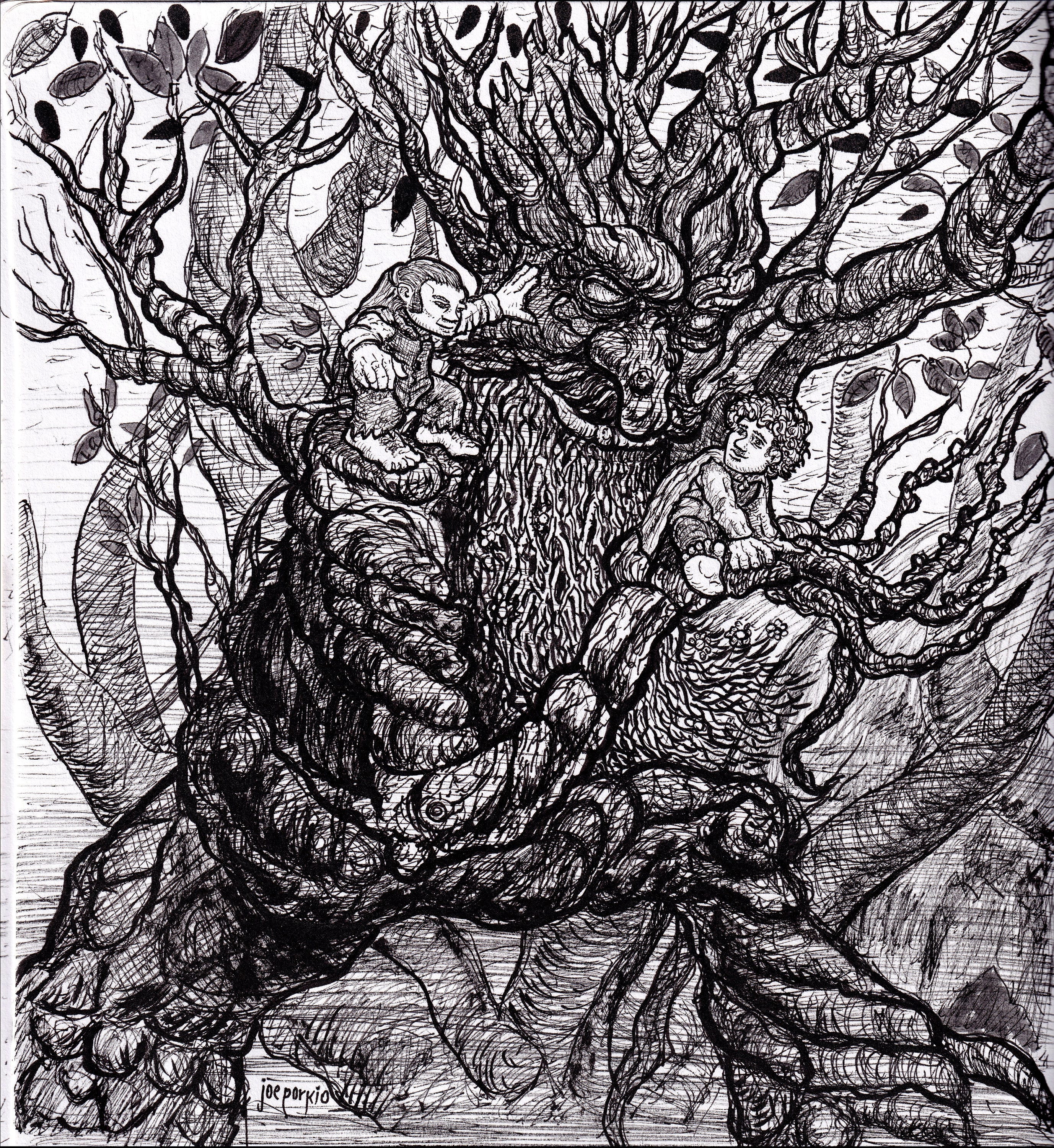
Even so, the combative contributions of Treebeard and the Ents on the military chessboard of the War of the Ring are indispensable. Without them, Sauron might well have prevailed, which can’t be said for Galadriel and the Elves of Lothlórien.
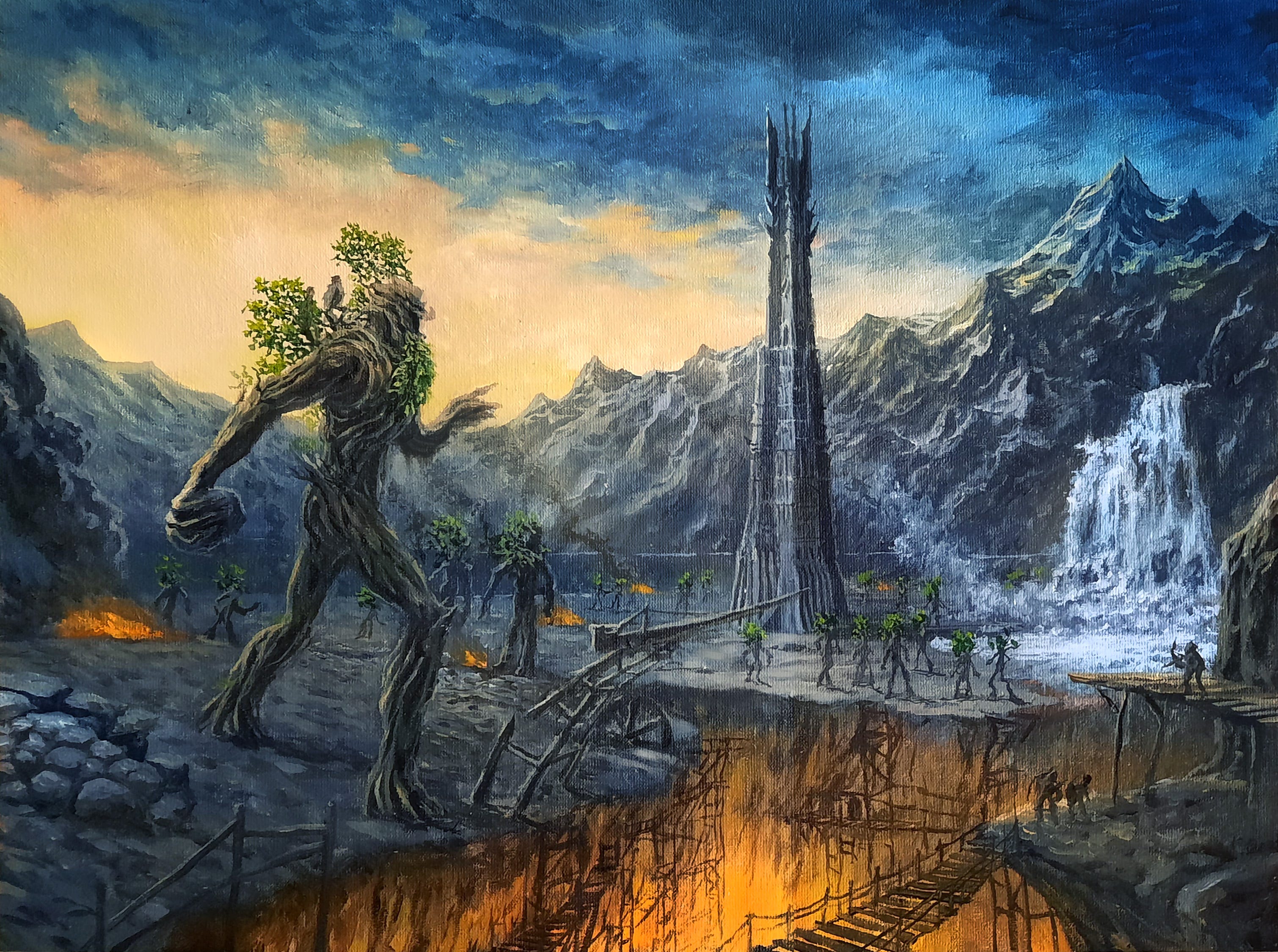
The assault on Isengard is a popular sequence in the book and the movies for good reason. Seeing the traitorous wizard Saruman get his due is gratifying, not just because he is a villainous person but for what he represents. Treebeard says of him: “He has a mind of metal and wheels; and he does not care for growing things, except as far as they serve him for the moment.” For Tolkien, who was dismayed by the destruction of the English countryside in the 20th century, especially the loss of forests, this characterization described too many people in his own society. Undoubtedly he would have loved to see Ents rise up against them. In our own time, the clear-cutting continues from Alaska to the Amazon and elsewhere, and wouldn’t it be delightful if Ents strode out of the forests to take out our own Sarumans? Personally I would leap at the chance to march alongside them, and I’m not alone in that sentiment. In the early 2000s, when I was involved in the forest defense movement in the Pacific Northwest, the tree-sitters and their allies greatly admired the Ents. (The Ewoks too, but that’s a whole nother legendarium, entertaining but far less sublime.)
Tolkien doesn’t directly narrate the attack on Isengard. Instead, the story is related by Merry and Pippin to Aragorn, Gimli and Legolas when the friends are reunited at the ruined fortress after the battle at Helm’s Deep. Merry depicts the initial wallop on the gates:
An angry Ent is terrifying. Their fingers, and their toes, just freeze on to rock; and they tear it up like bread-crust. It was like watching the work of great tree-roots in a hundred years, all packed into a few moments.
‘They pushed, pulled, tore, shook, and hammered; and clang-bang, crash-crack, in five minutes they had these huge gates just lying in ruin; and some were already beginning to eat into the walls, like rabbits in a sand-pit.
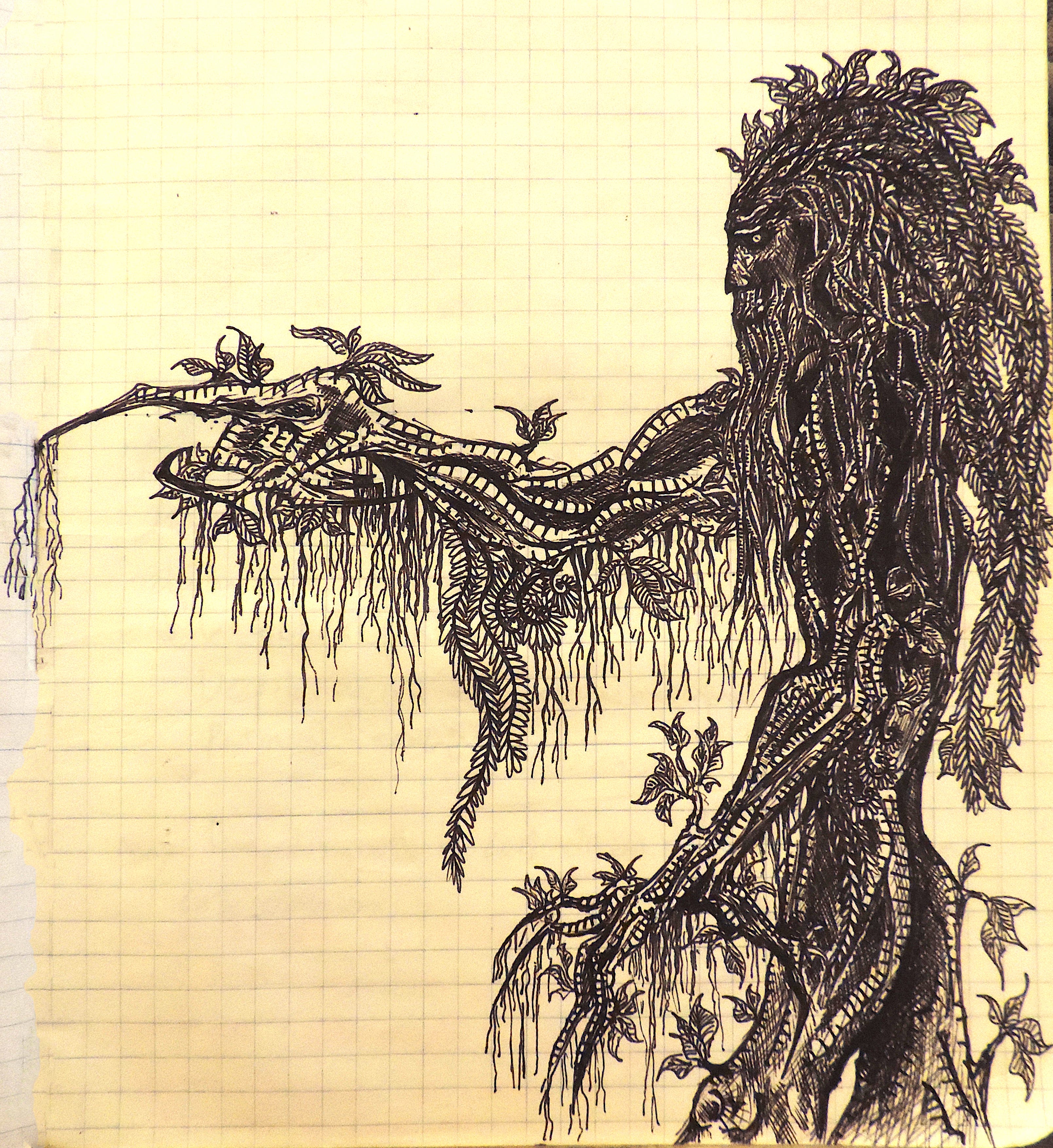
Tolkien makes the Ents believable by characterizing their actions as typical of trees, just faster. Anyone who has seen a tree growing out of an old rock wall or even just pushing up the sidewalk can picture what he means. Pippin describes the scene when the Ents break in:
It was staggering. They roared and boomed and trumpeted, until stones began to crack and fall at the mere noise of them. Merry and I lay on the ground and stuffed our cloaks into our ears. Round and round the rock of Orthanc the Ents went striding and storming like a howling gale, breaking pillars, hurling avalanches of boulders down the shafts, tossing up huge slabs of stone into the air like leaves. The tower was in the middle of a spinning whirlwind. I saw iron posts and blocks of masonry go rocketing up hundreds of feet, and smash against the windows of Orthanc.
Then the Ents switch tactics. After leaving a few sentries to make sure Saruman doesn’t escape from the tower, they disappear into the landscape above Isengard, from which Merry and Pippin hear “the rattle and fall of stone, and thudding noises echoing in the hills.” They are busying themselves damming every spring and stream, which they redirect into Isengard late that night as one big gushing flow, drowning the circle of the walled fortress and stranding the central tower as an island. The flood pours into the subterranean caverns housing Saruman’s machinery, dousing his furnaces and fires and sending up clouds of steam. His industrial operation is wrecked.
But the action isn’t limited to Isengard. Arguably the more significant event in the context of the War is what happens at the battle of Helm’s Deep, which also involves “Huorns.” Merry says Huorns are
Ents that have become almost like trees, at least to look at. They stand here and there in the wood or under its eaves, silent, watching endlessly over the trees; but deep in the darkest dales there are hundreds and hundreds of them.
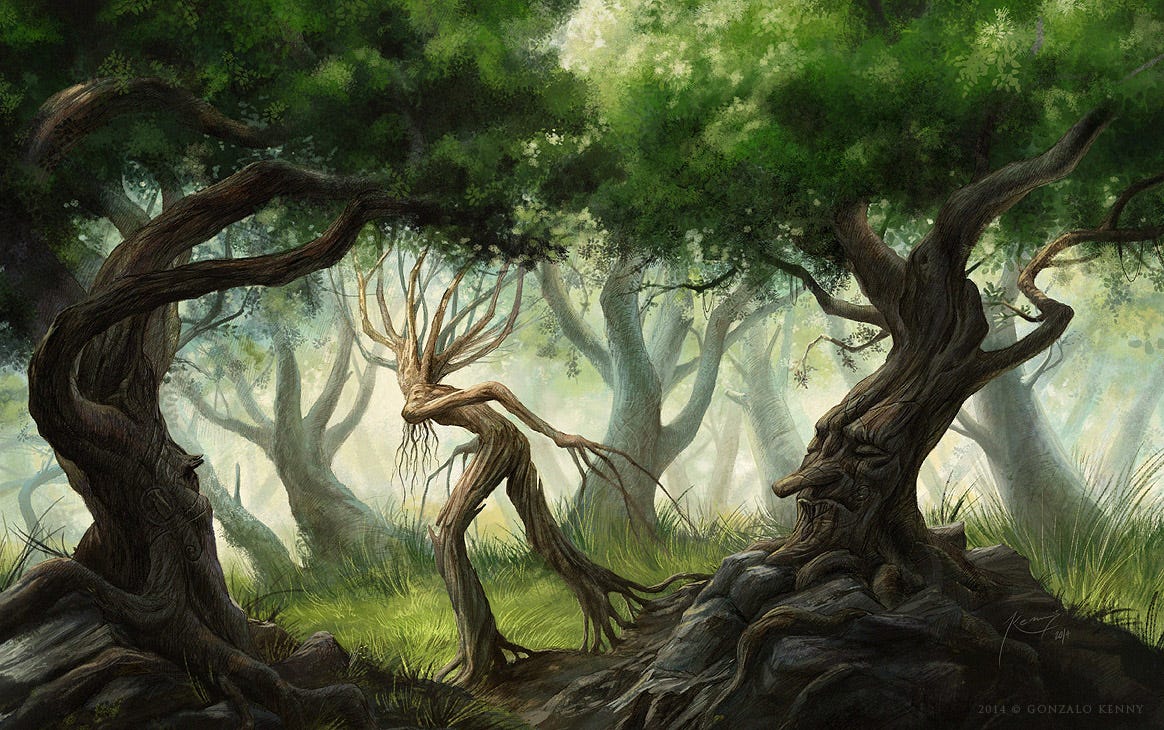
On the way to Isengard, Pippin sees Huorns following the Ents, though he doesn’t know what they are at that point:
Where the dim bare slopes that they had crossed should lie, he thought he saw groves of trees. But they were moving! Could it be that the trees of Fangorn were awake, and the forest was rising, marching over the hills to war? He rubbed his eyes wondering if sleep and shadow had deceived him; but the great grey shapes moved steadily onward.
Hundreds of Huorns, shepherded by Ents, go to Helm’s Deep, following Saruman’s army. After a bitter pitched battle over the night between the forces of Rohan one side and Saruman’s orcs, half-orcs and Dunland recruits on the other, Aragorn and King Theoden look out over the valley beyond the walls in the morning. They see a strange sight:
The land had changed. Where before the green dale had lain, its grassy slopes lapping the ever-mounting hills, there now a forest loomed. Great trees, bare and silent, stood, rank on rank, with tangled bough and hoary head; their twisted roots were buried in the long green grass. Darkness was under them.
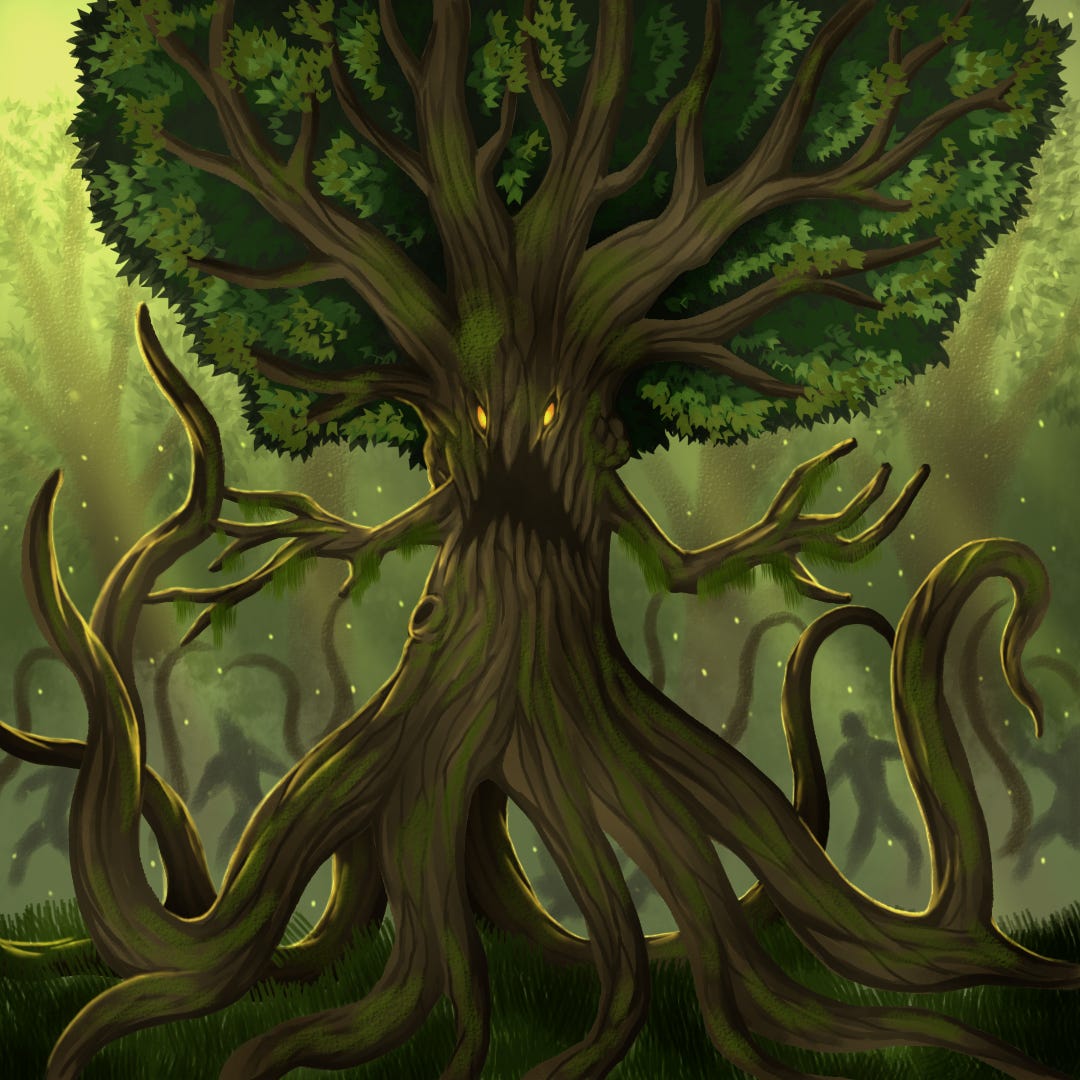
Saruman’s army is now trapped between Helm’s Deep, newly arrived reinforcements led by Gandalf, and the mysterious forest. Panicked, the orcs flee into the shadow of the trees from which not a single one every emerges again. The next day, when Gandalf, Theoden and company set off to visit Isengard, they take a road left open by the new forest, and we get the most detailed picture of the Huorns in the whole book:
The trees were grey and menacing, and a shadow or a mist was about them. The ends of their long sweeping boughs hung down like searching fingers, their roots stood up from the ground like the limbs of strange monsters, and dark caverns opened beneath them… there they heard the creaking and groaning of boughs, and far cries, and a rumour of wordless voices, murmuring angrily.
Without the Ents and Huorns, Helm’s Deep would likely have been in a worst case scenario, a loss, and in a best one, a long siege. In either case, the Riders of Rohan would not have arrived at Minas Tirith at the nick of time during the Battle of the Pelennor Fields and Gandalf might never have been there at all. When the Witch King broke the gates of the city, no one would have stood in the way. Eowyn would not have slain him. Minas Tirith might have been halfway sacked by the time Aragorn sail up the river in the Black Fleet later that day. Even if his valor and men were enough to beat back the assault that day, the remaining numbers to march to the Black Gate would have been significantly smaller, not just because Rohan wasn’t there, but because they would’ve taken heavier casualties in their absence. Would they have been so diminished that they couldn’t even credibly attempt that tactic at all? It was their seemingly hopeless effort that distracted Sauron and gave Frodo and Sam the chance to reach Mt. Doom undetected, as they did.
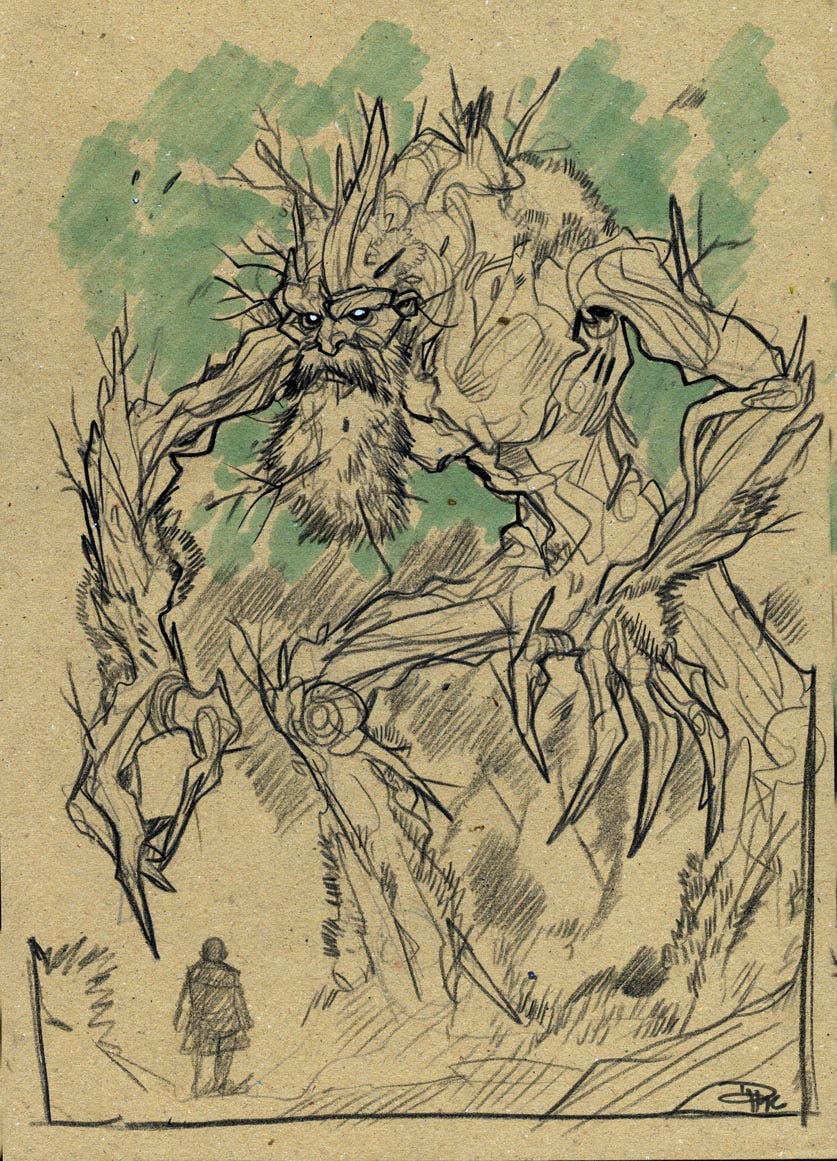
You can play a lot of “what if” scenarios with LotR. The successful destruction of the Ring and the defeat of Sauron occurred only because of a multitude of events, big and small, but it’s fairly plain that the Ents were a decisive factor. Which is ironic since the dawning of the new age meant their time was drawing to a close.
The origins of the Ents
The origins of Ents lay in deep time, in the Days of the Two Trees, when only divine figures lived in the world, well before Elves, humans, and other peoples. As Tolkien tells in The Silmarillion, Aulë, lord of stones and metals, and the greatest of blacksmiths, secretly created the Dwarves because he wanted “things other than I am, to love and to teach.” He is caught by Ilúvatar—the supreme being in Tolkien’s legendarium—who reprimands him but allows the creatures to live. They are put into a deep sleep, though, not to awaken until after Ilúvatar’s beloved first born, the Elves.
Aulë’s spouse is Yavanna. She is a nature goddess, “the lover of all things that grow in the earth.” When she learns of Aulë’s deed and Ilúvatar’s blessing, she is distraught because the Dwarves will cut down her trees for their foundries. “Many a tree shall feel the bite of their iron without pity,” she says to him, to which Aulë responds that all the children of Ilúvatar will do the same because they will have “dominion” over the world. (The use of this word is the only instance I know of when the devoutly Catholic Tolkien directly borrowed from the Bible, tragically in my mind, as the “dominion over the earth” might be the very worst invention of Abrahamic religion.)
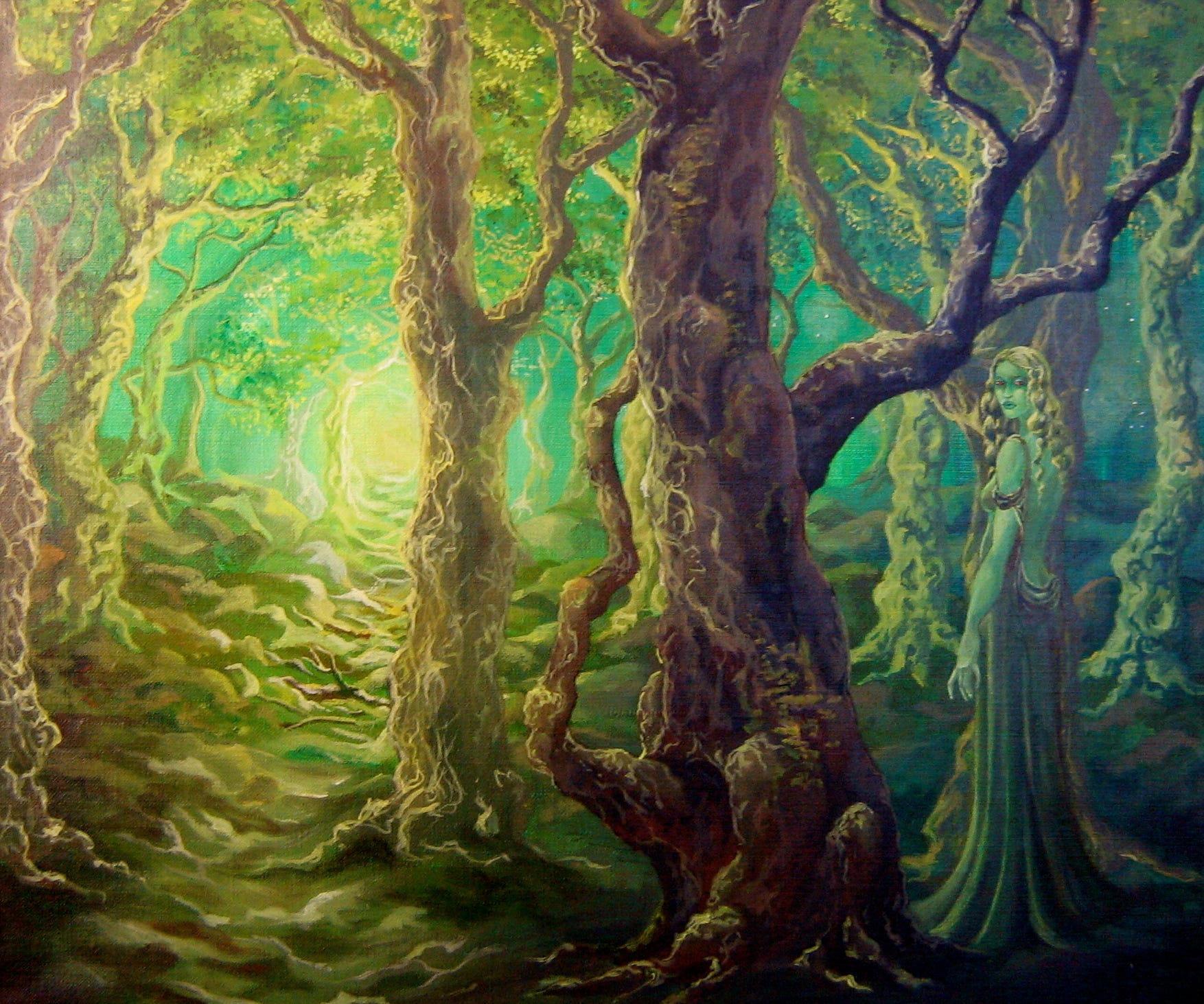
Yavanna, grieved, complains to Manwë, lord of the air and the heavens, who is closest of all the divine beings to Ilúvatar. She tells him:
I hold trees dear. Long in the growing, swift shall they be in the felling, and unless they pay toll with fruit upon bough little mourned in their passing. So I see in my thought. Would that the trees might speak on behalf of all things that have roots, and punish those that wrong them!
Manwë puts this thought “into his heart” where Ilúvatar reveals to him that
When the Children awake, then the thought of Yavanna will awake also, and it will summon spirits from afar, and they will go among the kelvar [animals] and the olvar [plants], and some will dwell therein, and be held in reverence, and their just anger shall be feared… In the forests shall walk the Shepherds of the Trees.
Note that the spirits go among the animals and plants, not into them. They take their own forms and dwell with the animals and plants. In the same conversation, Manwë reveals that the great eagles are a similar case.
The Ents are mentioned once in The Silmarillion, during the First Age of the Middle-earth, when Elves were fighting the war of the Silmarils against Morgoth. Dwarves have just ransacked an Elven kingdom (an incident still remembered and resented by Elves in the Third Age) and were returning home to their cities in the mountains. However they are taken by surprise in the forest by Elves led by Beren, the renowned human warrior:
There very many of the Dwarves were slain in the first onset; but some escaping from the ambush held together, and fled eastwards towards the mountains. And as they climbed the long slopes beneath Mount Dolmed there came forth the Shepherds of the Trees, and they drove the Dwarves into the shadowy woods of Ered Lindon: whence, it is said, came never one to climb the high passes that led to their homes.
This is one case among many of Tolkien going back and adding to older stories after discovering (or “reporting”) novel things in newer ones. The tale always grew with the telling.
The “botany” of Ents
Are Ents trees who have gained the ability to walk and talk? As with other questions, Tolkien is not totally clear, but the preponderance of evidence suggests that no, they are their own separate race of beings, if divine in origin as told above.
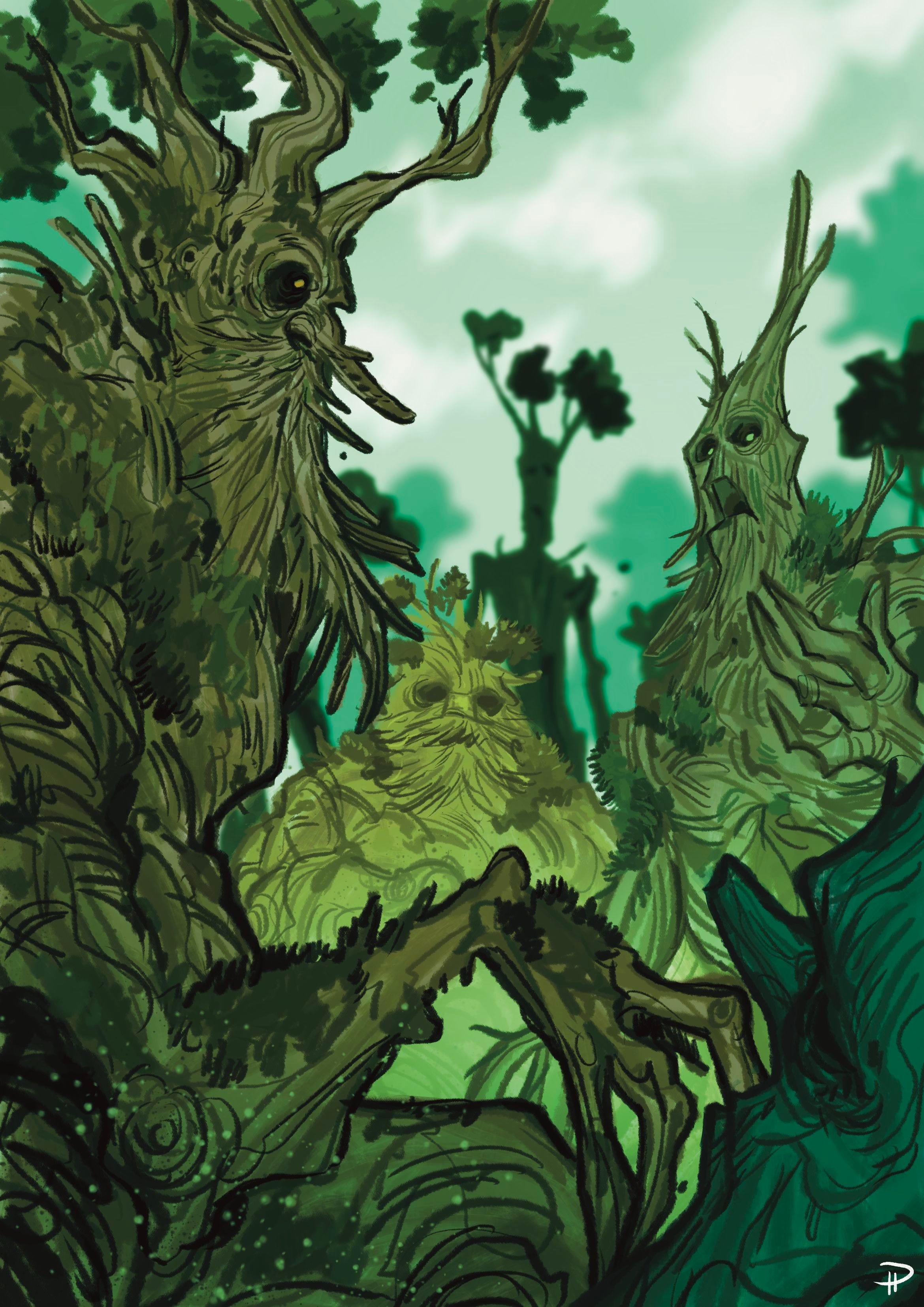
Tolkien describes Ents as “man-like” and likens them to trolls, who are humanoid creatures with ordinary bodies: two legs, two arms, etc. (notwithstanding The Hobbit’s reference to multi-headed trolls). While Merry and Pippin can’t tell if the bark-like covering on Treebeard is clothing or his “hide,” his arms are described as covered with “smooth skin.” At Entmoot, they are struck by the variety of shapes, colors, girths, and heights of different Ents as well as the varying lengths of their arms and legs. Their number of fingers and toes ranges from three to nine. “The Ents were as different from one another as trees from trees: some as different as one tree is from another of the same name but quite different growth and history; and some as different as one tree-kind from another.”
Individual Ents also resemble particular species of trees:
A few seemed more or less related to Treebeard, and reminded them of beech-trees or oaks. But there were other kinds. Some recalled the chestnut: brown-skinned Ents with large splayfingered hands, and short thick legs. Some recalled the ash: tall straight grey Ents with many-fingered hands and long legs; some the fir (the tallest Ents), and others the birch, the rowan, and the linden.
Tolkien’s appreciation for the diversity of trees in both kind and form is conspicuous in these passages. Here is someone who really loved trees.
At Helm’s Deep, a few Ents are observed by Gandalf, Theoden and company, and it’s less treelike than Merry and Pippin’s:
As tall as trolls they were, twelve feet or more in height; their strong bodies, stout as young trees, seemed to be clad with raiment or with hide of close-fitting grey and brown. Their limbs were long, and their hands had many fingers; their hair was stiff, and their beards grey-green as moss.
“Stout as young trees” and “beards grey-green as moss” are simple similes. Tolkien is not saying that they are young trees or that their beards are moss.
On the other hand, in a 1963 letter to Colonel Worskett, well after the publication of LotR, Tolkien is less definitive, writing that Ents were “either souls sent to inhabit trees, or else that slowly took the likeness of trees owing to their inborn love of trees” [my emphasis]. So add the question of what Ents “really” are to the unknown column.
The eventual fate of the Ents
Apparently Ents are, like the Elves, immortal. According to Treebeard, “None have died from inside, as you might say. Some have fallen in the evil chances of the long years.” This echoes The Silmarillion, which states of Elves, who we know to be immortal: “Elves die not till the world dies, unless they are slain or waste in grief.”
Still, Treebeard says that Ents can become “tree-ish,” barely moving anymore. “Sheep get like shepherds, and shepherds like sheep, it is said.” He names Leaflock is an example, who “has taken to standing by himself half-asleep all through the summer with the deep grass of the meadows round his knees.... He used to rouse up in winter; but of late he has been too drowsy to walk far even then.”
At the time of LotR, there have been no new Ents—no “Entings”—for thousands of years. This is because, as Treebeard sadly recollects to Merry and Pippin, the “Entwives” have been “lost.” Not that they died, he specifies, but the Ents have not seen the Entwives since the Second Age. Whereas the Ents loved the wild, the Entwives preferred to domesticate plants. When Morgoth (to whom Sauron was merely a lieutenant) came to northern Middle-earth after he destroyed the Two Trees of Valinor (see my previous essay), the Entwives fled east over the Anduin River and there tilled great fields of grains and fruits. Treebeard implies that humans learned many agricultural skills from them.
But in the Second Age, when Sauron set up shop in Mordor and war followed, the fields were desolated—“all burned and uprooted” says Treebeard—becoming what are known as “the Brown Lands” in LotR, desolate and unpeopled. In a 1954 letter to Naomi Mitchison, Tolkien surmises that those Entwives who weren’t immediately killed by Sauron might have been enslaved:
Tyrants even in such tales must have an economic and agricultural background to their soldiers and metal-workers. If any [Entwives] survived so, they would indeed be far estranged from the Ents, and any rapprochement would be difficult – unless experience of industrialized and militarized agriculture had made them a little more anarchic. I hope so. I don’t know.
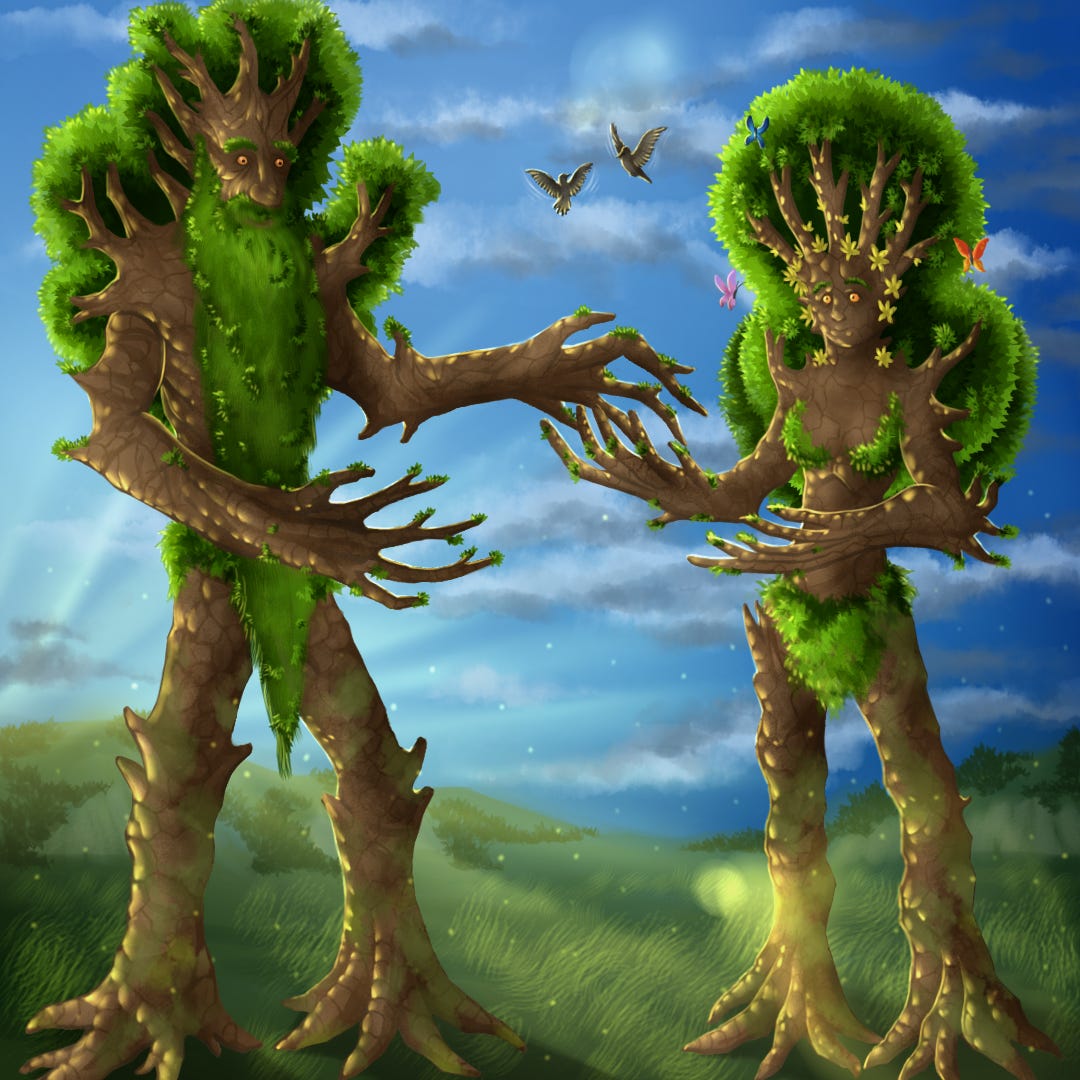
The Ents spent years searching for the Entwives, trekking great distances, but never found anything but rumor of them. Eventually they all but gave up, and rarely left Fangorn anymore. Treebeard adds:
We believe that we may meet again in a time to come, and perhaps we shall find somewhere a land where we can live together and both be content. But it is foreboded that that will only be when we have both lost all that we now have.
In fact it was so decreed by Manwë that the time of the Ents will be finite: “For a time: while the Firstborn [Elves] are in their power, and while the Secondborn [humans] are young.” That would be until the Fourth Age of Middle-earth, which is dawning with Aragorn’s reign in Gondor at the end of LotR.
So I’m disappointed to report that according to Tolkien, Ents are no longer around in our time (which is the Seventh Age, btw). Therefore the battle of Nature vs. Industry, the wild vs. exploitation, and freedom vs. oppression is ours to fight without them, though we can take inspiration from their spirit.

This is great! I've been reading Ellen Davis's agrarian re-reading of ancient hebrew scripture and was heartened to learn that the translation of dominion is contested. She notes that it can also be translated as "mastery among;" that the project of being on the earth is more communal in nature (entails a working together) than the standard reading of Genesis 1 would suggest (especially when read alongside Genesis 2).
What a lovely tribute to the ents! They were my favorite characters in the Lord of the Rings, and found many lines from Treebeard truly inspiring, and very quotable. Their wisdom, and quiet power are always an inspiration to me!